Primary objective
Run a prepared FARSITE case quickly and consistently with directional spread adjustments already defined.
The Fire module predicts wildfire spread in FARSITE using landscape, ignition, scenario inputs, and a directional ROS adjustment factor. It is prediction-oriented: the current service does not estimate or update that factor from satellite observations, but uses an already prepared factor to run wildfire spread simulation.
Run a prepared FARSITE case quickly and consistently with directional spread adjustments already defined.
The workflow stages landscape, ignition, and scenario data, applies an adjustment factor, and launches the wildfire spread simulation.
Simulated wildfire spread products generated from the packaged FARSITE run, rather than a new estimate of the directional ROS factor itself.
The current platform implements the prediction half of a larger wildfire-assimilation workflow.
In regional wildfire simulators such as FARSITE, one of the most important quantities controlling fire spread is the rate of spread (ROS). Because the raw ROS predicted from fuel, terrain, and weather data often differs from actual fire behavior, an adjustment factor is introduced to improve simulation accuracy:
Here, $ROS_i$ is the simulator's base rate of spread for fuel model $i$, and $\eta_i$ is the ROS adjustment factor. Once this factor is specified, FARSITE can generate wildfire perimeters, spread directions, and arrival-time outputs using the adjusted spread behavior.
Directional ROS adjustment factors can be updated in near real time from wildfire detections, but that estimation loop is not what this service runs. Instead, this module starts after those factors are already available and focuses on execution of the wildfire spread prediction itself.
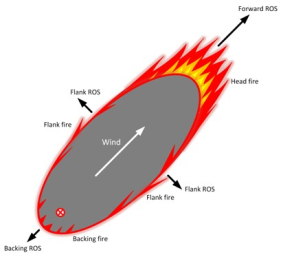
Fire spread is not uniform in every direction. Forward, flank, and backing directions can have very different rates of spread, which is why directional adjustment factors matter.
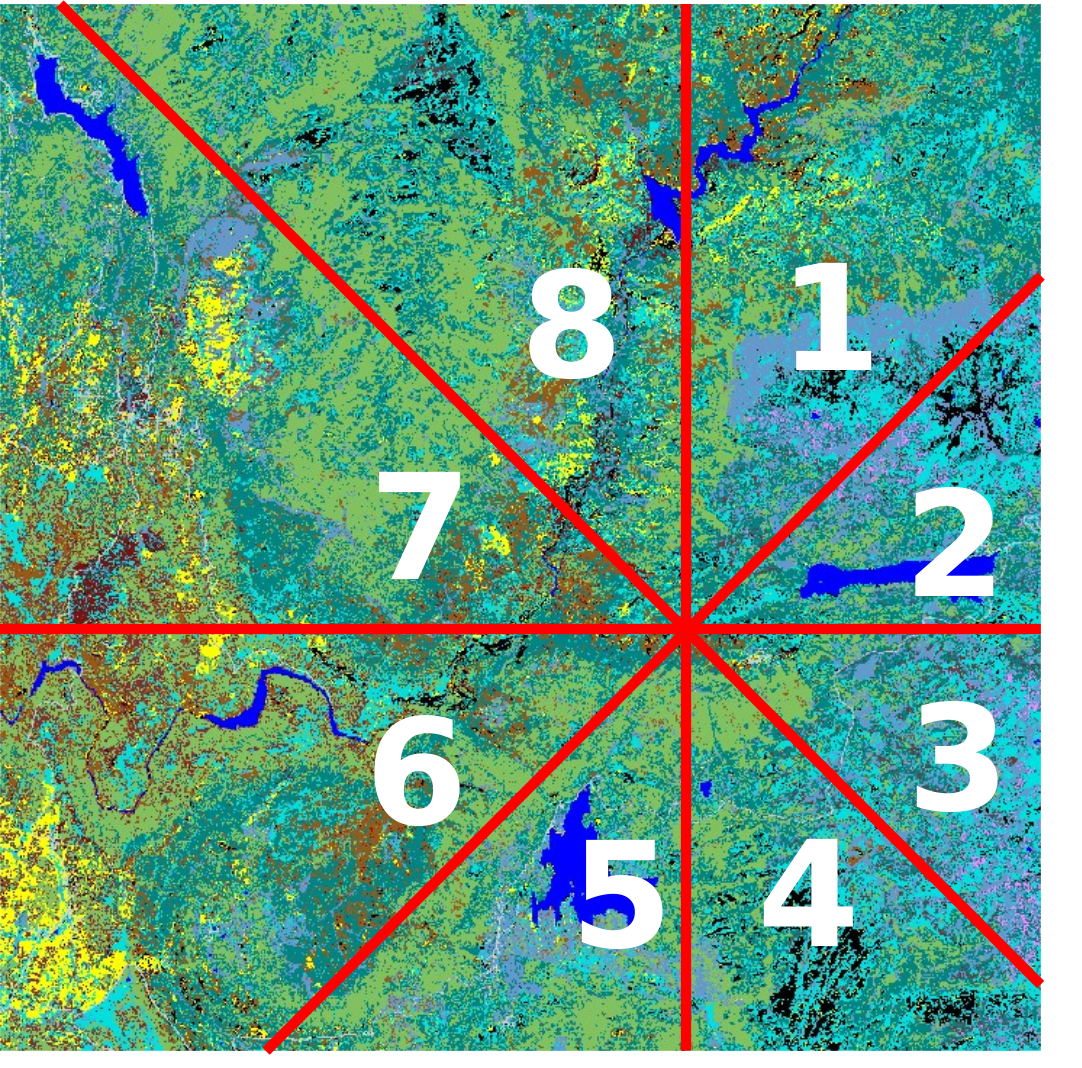
Directional sectors organize the ROS adjustment factors around the ignition region so that head-fire and flank-fire behavior remain distinguishable during prediction.
The workflow in this platform prepares the FARSITE case, stages the landscape and ignition data, applies the
provided ROS adjustment file, and runs wildfire spread simulation. If no custom adjustment file is supplied,
a built-in adjustfactor.adj template is used as the fallback.
Package the wildfire case as a single ZIP archive that contains the files FARSITE needs to run.
.zip file containing a complete FARSITE case package..lcp landscape file and one .input scenario file..shp, .shx, and .dbf..adj file can be included for the directional ROS adjustment factor. If it is omitted, the module uses the built-in adjustfactor.adj..prj are optional but recommended for map alignment and result visualization.